iTunes & App Store

Read Everything That Dunks Must Converge

Read Everything That Dunks Must Converge
by Bryan Harvey

Truth & lies in Pixar's 'The Good Dinosaur'

Truth & lies in Pixar's 'The Good Dinosaur'
by Bryan Harvey

A world of child soldiers & cowboys

A world of child soldiers & cowboys
by Bryan Harvey

To their own devices: Pablo Larrain's 'The Club'

To their own devices: Pablo Larrain's 'The Club'
by Bryan Harvey
Showing posts with label Oscars. Show all posts

What Oscar forgot: Finding Teyonah Parris' formation in Chi-raq

February 28, 2016

If anything, himself. 
First, Spike Lee’s Chi-raq (2015) is, especially upon one’s first viewing, an uneven, or at least unwieldly movie, and reactions to the film reveal it as such. After all, while the film garners only a 5.7 rating on IMDB, the film also topped Paste Magazine and The NewYorker’s best films of the year lists. The metamorphic girth of this satire makes it typical of Spike Lee’s artistic wheelhouse, which has less to do with George Lucas pastiche and Stephen Spielberg perfection than Woody Allen’s strolling rants. Even more, Spike Lee’s New York sensibility—his ranting away from traditional plot structures and streamlined coherence—places him in constellation with African-American satirists doubling as novelists.

A reflection on Alejandro Gonzàlez Iñàrritu’s 'The Revenant'

February 10, 2016

"Leo is a man. Are you a man?" "I;m not sure he is, Alejandro." "Guys, I'm totally a man. I'm like the dude of all men."
The best description I’ve seen of Alejandro Gonzàlez Iñàrritu’s most recent film was by some film critic on Twitter, who described seeing it at year’s end as akin to eating a steak dinner after having already gone through a buffet line. I can’t do better than that, but I will try in the name of Iñàrritu’s excess. I think he of all people will appreciate the masculine ego involved in such a task.

A reflection on Tom McCarthy's 'Spotlight'

January 20, 2016


Brittany Harvey has written at LCB in the past. Here she is again with some thoughts on the Oscar-nominated film Spotlight:

Having watched my son learn to crawl and walk over the last year, I have not seen many movies. However, I did see Tom McCarthy’s Spotlight (2015), and I cannot imagine many films, if any, being better. The acting, writing, directing, the score, etc. are all fantastic. When these things are good, however, it really just means that a film is a fine specimen of its craft. And, while Spotlight happens to be well-crafted, it also happens to be one of those rare movies that remind us why we stare at a big screen production in the first place. When Spotlight ends, you wish there were more, though you realize to add any more might spoil what is already perfect.

A reflection on Adam McKay's 'The Big Short'

January 12, 2016

They knew everything, and they knew nothing.
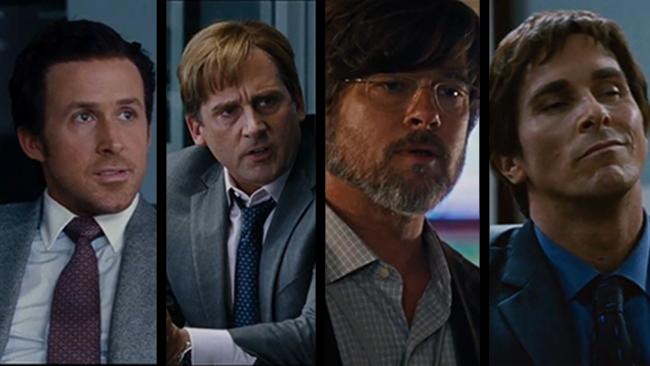
Starring Ryan Gosling, Christian Bale, Steve Carell, and Brad Pitt, The Big Short (2015) packs a great deal into what feels like a rather brief two hour and ten minute explanation of the 2008 housing crisis. This feat isn't really a surprise; Michael Lewis’ book covers the housing bust in a mere 200 pages or so. That said, Adam McKay's comedic talents as a director drive both the film's sense of brevity and its ability to surprise audiences through a conflation of two conflicting tones: the tragic and the comedic. 

A director whose reputation is staked on such films as Anchorman: The Legend of Ron Burgundy (2004) and Anchorman 2 (2013) is a somewhat unexpected choice to direct one of the first major films to do combat with Wall Street and the housing crisis. Except The Big Short's message would be just as helpful for curing Ron Burgundy of his goofball misogyny as it is in alerting civilians to the banking industry's habitual malpractice. The director's heart is in the right place and he is capable, but is the goal of the film even possible, that is to say, can a film, as opposed to a legislature or a tidal wave, solve a nation's financial woes?

When Gosling's Jared Vennett breaks the fourth wall at the start of the film, he's yelling, "Cannonball!" but adding a seriously guys before splashing into some rather deep waters. 

A reflection on James Marsh's 'The Theory of Everything'

March 17, 2015

Stephen Hawking is like the WAY smarter Mr. Darcy. 
There’s an AP prompt we give to the students almost every year. The excerpt the prompt asks the students to analyze is from John M. Barry’s The Great Influenza. In the passage Barry makes a comparison between scientists and explorers of the American frontier. James Marsh’s The Theory of Everything reminded me of this prompt.

A reflection on Chazelle's 'Whiplash'

February 26, 2015

Bryan to himself: I kind of miss drumming.

This review is about Damien Chazelle’s Whiplash, but before that, two sentences from the novel Percival Everett by Virgil Russell by Percival Everett:

That I then, you then, I now, could imagine such hell was hell enough. (213)
I could be writing you could be writing me could be writing you. (216).

I mention these lines from Everett’s very postmodernist text because this blurring of the lines between subject and object, between creator and created, between teacher and student, is at the heart of Chazelle’s film. And yet, Whiplash arrives at this hyphen without the appearance of either gimmick or contrivance, which is what separates it from both Inarritu’s Birdman and Linklater’s Boyhood.

Not only have Oscar ballots been cast but they have been announced. This conversation is old. Birdman won. And fans of every other film, but mostly Boyhood, have tweeted and blogged the ending of the world in accordance with such awful tragedy.

A reflection on Tyldum's 'The Imitation Game'

February 21, 2015

Am I a computer?
The Imitation Game is a war film, but the war is quiet. The tank's grinding gears and rough tread are the computer's whirring calculations and delicate tabulations. Any scenes of combat are black and white stock news footage. There is the war we know from The Longest Day, The History Channel, and Saving Private Ryan. And, for the most part, the war we know is one courage and virtue, of right versus wrong. The Imitation Game therefore is also, as the title suggests, about deception. And, to this point, Alan Turing's (Benedict Cumberbatch) machine named Christopher is housed in a barn, like some strange and futuristic horse.

A reflection on Inarritu's 'Birdman'

February 11, 2015


We saw Birdman and then a couple hours later I held my nephew. As he cried in my arms, we began to critique his constipation and fussiness. Considering his nine months of sonograms and check-ups, this may be the pattern of his life. Heck, it may be the pattern of all our lives.

A reflection on Linklater's 'Boyhood'

January 29, 2015


If anything Richard Linklater’s Boyhood is relatable for its commitment to story rather than plot. In fact, this commitment to Walter Benjamin’s idea of the story and the everyday is what drives every aspect of Linklater’s project. However, I do wish I’d seen the film before it was wrapped in paper expectations and ribbons of hype. In fact, I wish I could have seen it before knowing that the character Mason and the actor Ellar Coltrane, who played him, were aging simultaneously. It wouldn’t have taken long to discover such moments. The film’s soundtrack, which is more of a playlist, acts as a cue for these moments in aging. And that’s what this film is, moments, followed by moments waiting for something to happen, or not. This process does not render the film boring, but rather a realist impression of life. And, while this impression is in many ways uplifting, it is also somewhat troubling.

What Oscar Forgot: The Economics behind Greengrass' Captain Phillips

February 1, 2014

series of posts on films that possibly deserved more consideration than they received:


I don't know what people wrote about the film when it first came out in the early fall, and I don't know what people are writing about it now. I know a fall issue of The New Yorker sits in my bathroom opened to a review of the film, but I have yet to read it. On top of that opened New Yorker is about a year's worth of unopened New Yorkers--I don't know how anyone really "reads" The New Yorker. I also did not see this film in theaters. I saw it last night, at home, and I woke up this morning thinking about it.

What Oscar Forgot: Fruitvale Station

January 21, 2014

A series of posts on films that could have been nominated or perhaps never even stood a chance:


After watching Fruitvale Station, my wife and I hugged, exhaled, whispered, and took a walk in the cold air and crystallized snow. This film resonates, its power resounding from a world of real tragedy and regretable fact. The film opens with real footage of Oscar Grant III's death at the BART system's Fruitvale Station, and from there, it follows a day in the life of Oscar, each scene's daunting, yet subtle, importance magnified by knowing this man was real and did die unnecessarily. The film is understated on many levels. Race is obviously an issue, but the film does not force it, rather the indictment of racism is the lack of an explicit statement. The film need not state that such an environment exists, but reveals it gradually and persistently as a subtext that exists a posteriori.

Actions of regret are taken in an hour and a half introspection of a life that could have been lived for the better or for the worse, and, for the most part, the film does not partake in any melodrama and does not attempt to answer any of the hard questions that Oscar Grant's unseemly death surely raises. And that is the film's strength: its ability to ask without so much as a whisper. It does not speak, but exhales and you take that feeling of warmth escaping forever as the credits begin to roll in what feels all too soon and yet not soon enough.

Excuse Me, Mr. Oscar, You Forgot Something

February 21, 2012


Brittany Harvey is graduate student at Austin Theological Seminary. You may recognize some of her previous work here at LCB--she once wrote this on R.E.M. The work below is a yearly passion of hers:

After seeing this performance, the Academy should have nominated Gossling out of fear.


There are many critics out there making many predictions about who will be going home with
an eight pound, gold, naked man February 26. I am neither a critic nor a predictor of the future,
but I was a film studies minor and here are my thoughts on who got left out of the running this
year. In saying who got left out, I make no claims about any nominations that should have been
left out.


© 2008-2010 ·The Lawn Chair Boys by TNB