iTunes & App Store

Read Everything That Dunks Must Converge

Read Everything That Dunks Must Converge
by Bryan Harvey

Truth & lies in Pixar's 'The Good Dinosaur'

Truth & lies in Pixar's 'The Good Dinosaur'
by Bryan Harvey

A world of child soldiers & cowboys

A world of child soldiers & cowboys
by Bryan Harvey

To their own devices: Pablo Larrain's 'The Club'

To their own devices: Pablo Larrain's 'The Club'
by Bryan Harvey
Showing posts with label Films. Show all posts

A world of child soldiers and cowboys: 'Beasts of No Nation's' Extended Family Tree

July 28, 2016


And AK-47s that they shooting into heaven
Like they're trying to kill The Jetsons
                                                  --Lupe Fiasco, "Little Weapon"

Cary Joji Fukunaga’s film Beasts of No Nation (2015) began its journey as a novel by Uzodinma Iweala. Published in 2006, the film’s hypotext appeared on bookshelves a year earlier than Ishmael Beah’s bestselling memoir A Long Way Gone, which, although categorized as nonfiction, also began as a novel in a creative writing workshop. Around that same time, in 2008, Emmanuel Jal released his album Warchild, which received critical acclaim from publications like Rolling Stone. In other words, a general discourse about boy soldiers, colonialism in a post-colonial world, the relationships between violence and natural resources arose in the middle of the twenty-first century’s first decade, and this discourse could be equally packaged as either an entertainment commodity or a curriculum for high schoolers and neighborhood book clubs.

What Oscar forgot: Finding Teyonah Parris' formation in Chi-raq

February 28, 2016

If anything, himself. 
First, Spike Lee’s Chi-raq (2015) is, especially upon one’s first viewing, an uneven, or at least unwieldly movie, and reactions to the film reveal it as such. After all, while the film garners only a 5.7 rating on IMDB, the film also topped Paste Magazine and The NewYorker’s best films of the year lists. The metamorphic girth of this satire makes it typical of Spike Lee’s artistic wheelhouse, which has less to do with George Lucas pastiche and Stephen Spielberg perfection than Woody Allen’s strolling rants. Even more, Spike Lee’s New York sensibility—his ranting away from traditional plot structures and streamlined coherence—places him in constellation with African-American satirists doubling as novelists.

A reflection on Tom McCarthy's 'Spotlight'

January 20, 2016


Brittany Harvey has written at LCB in the past. Here she is again with some thoughts on the Oscar-nominated film Spotlight:

Having watched my son learn to crawl and walk over the last year, I have not seen many movies. However, I did see Tom McCarthy’s Spotlight (2015), and I cannot imagine many films, if any, being better. The acting, writing, directing, the score, etc. are all fantastic. When these things are good, however, it really just means that a film is a fine specimen of its craft. And, while Spotlight happens to be well-crafted, it also happens to be one of those rare movies that remind us why we stare at a big screen production in the first place. When Spotlight ends, you wish there were more, though you realize to add any more might spoil what is already perfect.

A reflection on Adam McKay's 'The Big Short'

January 12, 2016

They knew everything, and they knew nothing.
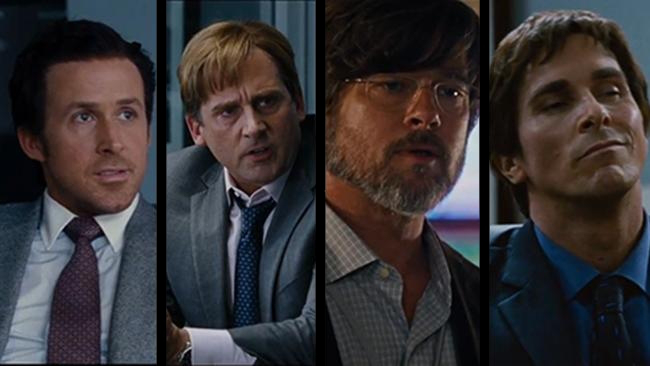
Starring Ryan Gosling, Christian Bale, Steve Carell, and Brad Pitt, The Big Short (2015) packs a great deal into what feels like a rather brief two hour and ten minute explanation of the 2008 housing crisis. This feat isn't really a surprise; Michael Lewis’ book covers the housing bust in a mere 200 pages or so. That said, Adam McKay's comedic talents as a director drive both the film's sense of brevity and its ability to surprise audiences through a conflation of two conflicting tones: the tragic and the comedic. 

A director whose reputation is staked on such films as Anchorman: The Legend of Ron Burgundy (2004) and Anchorman 2 (2013) is a somewhat unexpected choice to direct one of the first major films to do combat with Wall Street and the housing crisis. Except The Big Short's message would be just as helpful for curing Ron Burgundy of his goofball misogyny as it is in alerting civilians to the banking industry's habitual malpractice. The director's heart is in the right place and he is capable, but is the goal of the film even possible, that is to say, can a film, as opposed to a legislature or a tidal wave, solve a nation's financial woes?

When Gosling's Jared Vennett breaks the fourth wall at the start of the film, he's yelling, "Cannonball!" but adding a seriously guys before splashing into some rather deep waters. 

The films I will remember having watched in 2015:

December 29, 2015

Many of these films are from 2015. Many are not. Feel free to add to the list, make suggestions, or question certain choices. 

Have you read Orwell's "On Shooting an Elephant?" This is somehow similar.
’71 (2015)

Yann Demange’s film about the Irish Troubles is like a lot of other films and then not quite. In terms of its suspenseful plot and labyrinthine alleyways, ’71 walks in the shadows of film noir, looking and sounding like A Most Wanted Man (2013) but, in truth, feeling a great deal more like The Third Man (1949). The apartment buildings of Belfast are as dark and confusing as the sewers in Vienna, into which Harry Lime escapes only to be killed.

Year in Review: Eat, Prey, Dinosaur

December 28, 2015


Indominus Rex (voiced by Julia Roberts) had everything a modern genetically engineered dinosaur that never actually existed is supposed to dream of having - a security guard, a playpen with thermal sensors, a crane with a meat hook - yet like so many dinosaurs that were actually part of the historical record, she found herself lost, confused, and rampaging for what she really wanted in life. 

No Shane in Watching: A History of Violence

October 2, 2015

This started with Shane (1953) about a week ago and continues today with a look at David Cronenburg's take on an age old story: 


I first saw David Cronenburg’s A History of Violence (2005) in the late twilight of Blockbuster. I may have watched it with my parents. I remember having liked it. I remember it having to do with ‘history’ and with ‘violence.’ I watched it again recently. I still liked it. Maybe as much. Maybe not. I can’t quite remember.

Water from a Rock, reflecting on Mad Max: Fury Road

September 28, 2015

This wasn't supposed to be a review, but it sort of came out that way:

Finding a place to park at our house last night was disastrous.
If you look around the net for reviews of George Miller’s Mad Max: Fury Road (2015), you’re bound to find several critics proclaiming the film as Oscar worthy. I’m not here to say whether it is or isn’t, only that hearing such praise inevitably raises the expectation for what a film can or should deliver. Without these expectations, Mad Max is surely a large film, filled with desert storms and unreachable horizons. Its action could swallow anyone whole.

The joy of seeing this film in theaters last May, beyond its beauty and power on the big screen, was to see it with very little expectation. It came to theaters as a dark alternative to everything Marvel and, in that sense, ambushed the early summer. That said, to see Mad Max at home is another matter; the movie does not fit so well inside a living room.

No Shane in Watching

September 22, 2015

This post is in no way current. Then again, what was ever current about the Western? Anyway, I grew up flipping channels between X-Men and Bonanza on Saturday mornings, which meant I had trouble discerning between Little Joe's lost wives and Wolverine's lost memories. I talk about these things when introducing high school students to the idea that films, whether we like them or not, still deserve our attention on a variety of levels. Sometimes to help with that endeavor I write, too. That's what this was: 


Patience & pain in the cinematography of Timbuktu (2014)

September 6, 2015


The opening sequence is the metaphor for the entire hour and a half film. Some antelope or deer specimen sprints raggedly across the sand. Men with AK-47s and turbans to keep the dust from their eyes fire at it from a truck bed. The truck guzzles gas and desert miles. Until the film's closing sequence, nothing will move this fast, even the moments of violence in between will pass with the slow pain of an hourglass, perhaps it is not even that, but a kidney stone. 

Unneighborly Neighbors: Comedic gaps in cinema

August 10, 2015

Brittany Harvey offers a much-belated criticism of  Nicholas Stoller's Neighbors (2014):


I realize writing about this movie is not exactly timely, considering when it came out, but my husband and I just watched it. It was dumb. I like a lot of dumb movies—usually those starring former cast members of Freaks and Geeks are my favorites—but even Seth Rogan could not pull this one out of the depths of its excuses for humor. Basically, it is a movie about a bunch of people who are all discontent with their present lives, who through the unsuspecting plot twists and wild antics, realize their lives are not that bad. The problem is that in order to arrive at the newly found contentment, all the characters must be absolutely, unrelenting in their awfulness toward one another. Violence, lies, deception, adultery, and tattle tales are the means every character uses to relate to one another. The depiction of humanity the movie creates is bleak, and we are supposed to laugh right along as neighbors fight each other, launch firecrackers at one another, and drink each other to oblivion.

Rewiring all the geeks: a review of Alex Garland's Ex Machina

July 27, 2015

Two bros.
Alex Garland’s Ex Machina (2015) may be a near perfect film. If a problem exists, it may result from being a film about artificial intelligence that is, perhaps, too self-aware in its thinking about self-awareness.

Story & Plot in Love & Mercy: A trio of Brian Wilson, Ray Charles, & Johnny Cash

July 22, 2015


Biopics of any sort are always risky in that they are inevitably predictable. Such is the nature of a rather tame beast. After all, the life and events of the film’s subject matter tend to be already etched in the minds of the audience before ticket is even bought. Moreover, because the story is not only known but known to be real, the genre is often overly conservative in how predictable it is, relying on imitation over innovation.

Sharing a Funny Bone: Welcome to Me (2014) & Birdman (2014)

July 14, 2015


"Am I a Birdwoman?"
This is not so much a review of Shira Piven’s Welcome to Me (2014) as a glance at some of the questions it raises.
              
The film is a good one, if you enjoy dark comedy and a particular brand of Kristen Wiig quirkiness. If not, then this film probably is not meant for you. Part Alejandro G. Iñárritu’s Birdman (2014) and part Noah Baumbach’s Greenberg (2010), Welcome to Me is not quite as energetic and ambitious as the former while also not quite as dull in its vanity as the latter. Furthermore, the film probably has too much Saturday Night Live in its DNA--think Molly Shannon’s turn in Superstar (1999) and Steve Martin’s The Jerk (1979)--to move entirely beyond the veils of sketch comedy stretched like taffy over just under an hour and a half. 

Still, something about the film’s subtleties allows it to clarify some of the murk and shadow in Birdman’s attempted monolith, such as the relationship between mental illness, the production of media, and said media’s consumption. Both of these films contain messy, untidy areas, but they also reveal a brand of comedy that takes what we laugh at more seriously than the comedies most of us were raised on--the human brain is fraught with laughter. The stage is set. The joke is told. The punch line is Wiig’s Alice Klieg walking naked through a casino floor, her body covered in red welts and burn scars. Or, the punch line is Michael Keaton’s Riggan rushing down Broadway in nothing but his underwear, hoping the world will not see him for what he is. Despite one’s male focus and the other’s attention to the female, these two films both appear to be shaped from the same funny bone: Adam’s rib. 

While Welcome to Me makes obvious attempts to be at the forefront of feminist comedy, the similarities with male comedies and male protagonists raises if not questions about the world at large, then at least the stories we share about that world. 

The arrival of female protagonists in mainstream media outlets has been a triumph, having already arrived near or past the tipping point in what we as audience members expect from the bodies of our heroes. From Tina Fey to Amy Poehler to the sisters in Frozen and the rise of Amy Schumer (the list could be much longer), the gender of the story is shifting away from the male body and towards the female. This change is not something that will occur. This change is already occurring. And, in this shift, archetypes appear to be unraveling under the strains of both adaptation and appropriation. These female heroines, for better or worse, make their selves known to us through variations of the stories we already know. 


"I was totally on the cutting edge before that Frozen movie."

What Welcome to Me reveals is that perhaps our hopes for the female protagonist are somewhat utopian. This does not mean we should return to having more male heroes, but that perhaps we should reassess the constraints of patriarchal societies. It seems that as we build narratives out of the old tales we are still writing within those tales and that Piven’s Alice Klieg’s attempts to buy airtime in order to talk about herself are not entirely removed from what occurs in Riggan’s dressing room tirades. 


Of course, one conversation is an ascent and the other a descent, but even in those movements there is a similar shape and scope; a symmetry not that far removed from a planet’s orbit round the sun. Hence, these plots seem more durable than our gendered selves. 

Bryan Harvey can be followed @LawnChairBoys.

American Sniper, or Clint Eastwood's reduction of a soldier's life

June 29, 2015

Wait, so you're telling me, Bradley Cooper, that I'm not the real Chris Kyle?
I finally watched Clint Eastwood’s Oscar-nominated American Sniper (2014). I had avoided the film largely because I thought it would be impossible to view it on its own terms, rather than as a lynchpin in political debates over U.S. foreign policy or arguments over the role of art in depictions of war. I thought perhaps enough time had passed since the furor of Oscar-season that I could hash the film out of opinion’s rubble and view for what it is. I admit such a task is probably foolhardy and vain on my part, but, regardless, what I found in American Sniper is a rather mundane film for its lack of ambition and attempts to avoid controversy.

The Cinematography in Mr. Turner: Can you see the elephant?

June 27, 2015

See if you can find the man in a red & white stripes.

Mr. Turner (2014) is a seemingly slow and methodical film. The consumption of which at two and a half hours is a rather daunting task. After all, the closest the film comes to offering either goblin or cave troll to its audience members is the perpetual grunting of its title character (played by Timothy Spall). And yet to reshape the film by cutting time or to have made its pace anything quicker than a stroll would have been to photo shop director and writer Mike Leigh’s vision into something compressed and claustrophobic.

A Puck the Size of a Whale: Conversing on Leviathan & Red Army

June 18, 2015


Andrey Zvyagintsev’s Leviathan (2014) begins where the ocean meets the sand. The skeleton of a whale marks in the shape of a prehistoric fence marks the boundary. The tides lap at the pale bones, the coastal cliffs, and gray rocks. Almost everything appears lost in its own shape.

End of Watch revisited: What's a cop in a world full of anti-heroes?

April 16, 2015

Other film reviews by Bryan Harvey can be found here. What follows is a reflection on End of Watch (2012) in respect to the ongoing crisis between the police and U.S. citizens. It’s also a thank you:


One of my earliest film memories is of the time when my parents allowed my sister and me to watch George Roy Hill’s Butch Cassidy and the Sundance Kid (1969) on VHS. The frozen image of the two title characters running, guns drawn, to meet their deaths is, if not an image I was biologically crafted to like, then an image that crafted my taste in films from that moment forward. I could not understand how these two outlaw heroes could not simply blast their way towards survival.  How could they not be Han Solo and Luke Skywalker? How could they not beat the odds? The image both disturbed and haunted me. The image became something by which to judge the merits of other films.

A reflection on James Marsh's 'The Theory of Everything'

March 17, 2015

Stephen Hawking is like the WAY smarter Mr. Darcy. 
There’s an AP prompt we give to the students almost every year. The excerpt the prompt asks the students to analyze is from John M. Barry’s The Great Influenza. In the passage Barry makes a comparison between scientists and explorers of the American frontier. James Marsh’s The Theory of Everything reminded me of this prompt.

Joon-ho Bong's 'Snowpiercer': just see it already

March 13, 2015

Written to avoid giving everything away, but some spoilers couldn't be helped:


Perhaps because they both feature memorable scenes with edible bars Snowpiercer reminded me of Charlie and the Chocolate Factory. Of course, such a compartmentalized journey towards promised truths as the one directed by Joon-ho Bong is also reminiscent of the always popular Alice in Wonderland or the ever prosaic Matrix trilogy. This story is not a new one. Plato could recite it. After all, what is a train but a cave traveling at hundreds of miles per hour? However, the trick to presenting familiar questions with even more familiar answers—such as a revolution waiting on a messiah—is always in the presentation. A cave becomes Wonderland becomes Oz becomes a farm with rebellious pigs becomes a chocolate factory becomes a train. Often times, these changes in illusory settings are cosmetic. But the grittiness of Bong’s train allows for alternative solutions, seemingly.
 

© 2008-2010 ·The Lawn Chair Boys by TNB